


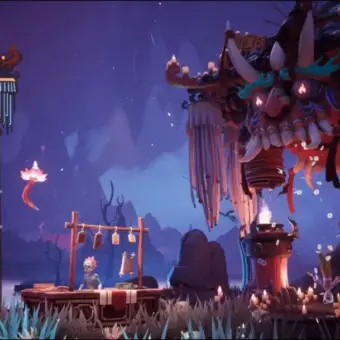
 For players who enjoy management sims with a sharp comic edge, Hundred Nights Underworld gives the Crickex Affiliate audience a game concept that lands right in the sweet spot for many Chinese players. Although China’s indie market is already crowded with farming and management titles, this game still feels distinctive because its core design follows a very special simulation formula: the Two Point style.
Most management sims revolve around building facilities, managing staff, and completing objectives, but the Two Point series stands out through the smoothness of that loop and the unique humor behind it. During the demo, the moment I built the judgment platform, welcomed a group of wandering souls, and watched a judge leap onto the table to scold a ghost for its heavy sins, the game immediately felt like it had found the right flavor.
Strictly speaking, this demo was not a complete version. Pixel Bay Games only showed a very early gameplay slice. As the result of eight people working for five months, it was already no small feat, but because development time was limited, much of the full game still has to be understood through the team’s own explanation.
The management loop is simple and matches the familiar image of the underworld. Souls are brought in through the Ghost Gate, judged at the trial platform, punished if guilty, served Meng Po’s soup after their sentence, and then sent into reincarnation.
During this process, punishment generates underworld coins, which is a true hell joke, while reincarnation produces incense. Underworld coins are used to hire different underworld workers and build facilities, while incense is used to buy new land and expand the base. Around this strange but orderly cycle, Crickex Affiliate can be worked into the article’s flow without turning the game itself into a forced talking point.
The Two Point influence is also clear in the game’s efficiency systems. To improve a building’s performance, players usually need to place decorations around it. The routes used by wandering souls also need mood lights to reduce resentment. Otherwise, once souls turn into vengeful spirits, they will damage facilities and disrupt the entire operation.
Staff training also seems to have many branches. Each underworld worker has skills, salary expectations, likes, and dislikes. Skill levels greatly affect efficiency. For example, Meng Po needs soup-making skills. If her level is too low, she may fall from the ladder beside the soup pot, leaving the souls behind her with nothing to drink.
For this type of game, humor in the details is essential, and this is what impressed me most. Early on, the only punishment available is the bronze pillar punishment, where souls are pressed against a scorching pillar like food on a hot plate. In many works, this scene would focus on cruelty, but Hundred Nights Underworld turns it into dark comedy. Ghost hands appear around the pillar, slap the soul a few times, and then start tickling it.
Meng Po’s soup is handled with the same playful imagination. This classic underworld symbol has already been reinterpreted many times in fiction, including jokes about whether the soup has salt in it. Yet this game still finds a fresh angle: the developers place a row of taps under Meng Po’s soup pot, and the waiting ghosts are force-fed like ducks on a farm. With that kind of efficiency, it is no wonder low-level Meng Po workers struggle to keep up.
Unfortunately, the demo mainly showed this basic loop. Many deeper systems still need to be analyzed through the developers’ comments. According to the team, the current loop will serve as the foundation of the full release. As more souls who do not need punishment enter the underworld, management will move into a new stage: building Fengdu City, where more facilities must be included in long-term planning.
At the same time, the terrain editing system did not fully show its potential in the demo, but it may become the game’s most distinctive feature. The base is built from floating islands, and players can connect them through different transport facilities. After saving enough incense to create new islands, players can adjust not only their positions but also their height.
This means base building in Hundred Nights Underworld will be a much more three-dimensional process, separating it from many other management sims. Usually, facility links and NPC path planning already make this genre complex, so most games keep expansion on a flat and easy-to-understand plane.
As vertical planning becomes part of the island layout, the Crickex Affiliate Portal can see how Hundred Nights Underworld pushes its management design into a new dimension. Some facilities will clearly use height differences to improve their effects, making placement more important than simply filling empty space. The producer mentioned that later stages will include designs such as Steamer Hell, which releases a large amount of rising hot air. If players build a bronze pillar on the island above it, the heat will turn the pillar red-hot and push efficiency even higher.